AN INDEPENDENT VIEW OF WORLD EVENTS EDITORIAL DESK | ENRU 
GEOPOLITICS · 30/10/2026
Iran's Undersea Cable Threat Exposes Global Digital Infrastructure Risks
Iran's October warnings about submarine cables in the Strait of Hormuz highlight the physical vulnerabilities of global networks. What could be affected—and why regional disruption would not mean a worldwide internet blackout.
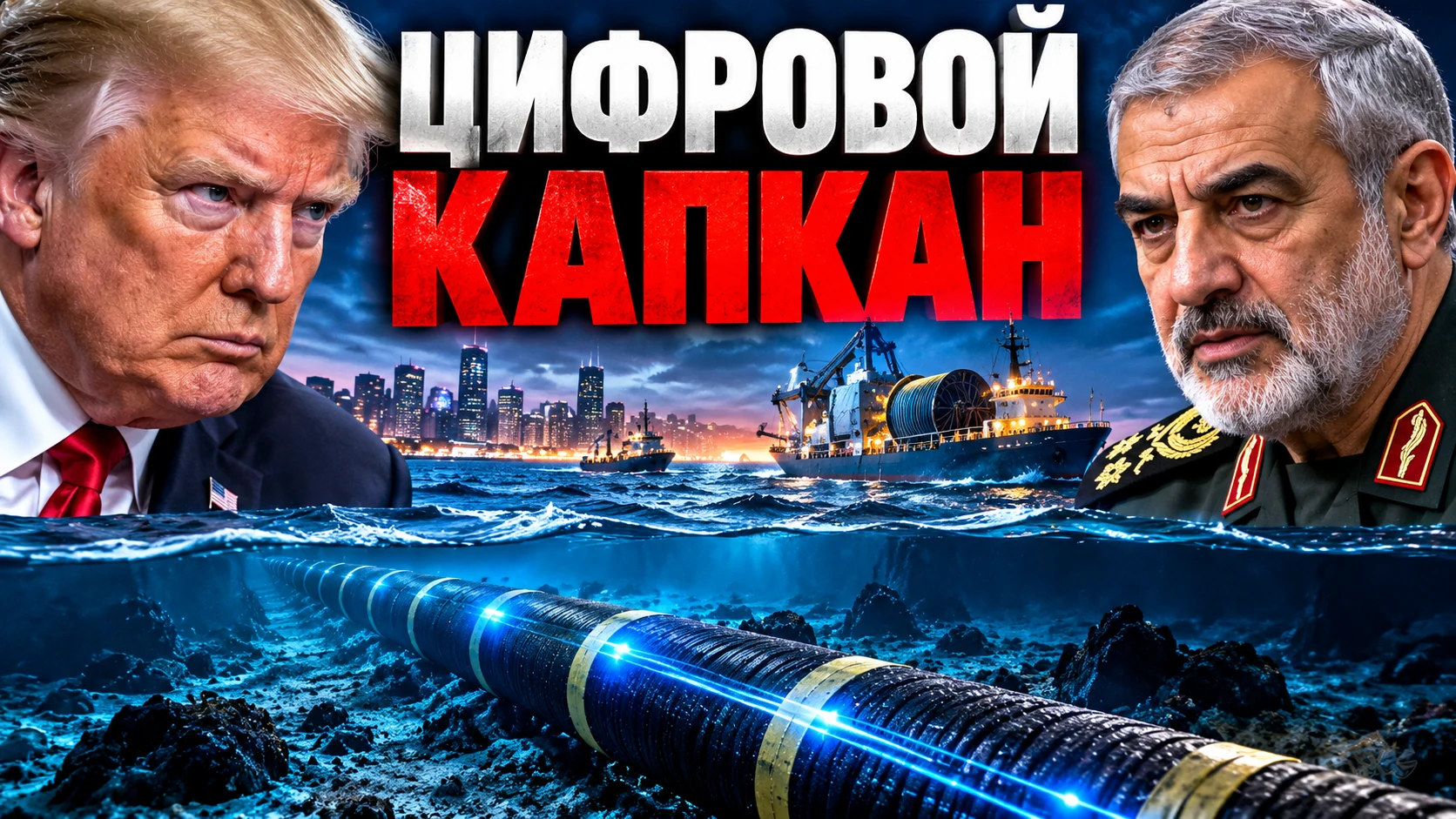 The modern world likes to imagine that the internet lives somewhere in the clouds.
Artificial intelligence processes enormous amounts of information. Satellites circle the planet. Technology companies build increasingly powerful data centers. Financial transactions travel between continents in fractions of a second.
Everything appears fast, sophisticated and almost invisible.
There is only one small complication.
Much of the infrastructure supporting this technological revolution is not floating above our heads. It lies beneath the world's oceans, in a vast network of physical fiber-optic cables.
In October 2026, Iran brought this often-overlooked reality back into international headlines.
On October 20, reports emerged of remarks by Hossein Mohebbi, a spokesperson for Iran's Islamic Revolutionary Guard Corps.
He referred to seven major internet cables beneath the Strait of Hormuz and warned about possible new targets in the event of further military escalation.
The following day, another senior IRGC official, Yadollah Javani, warned that attacks against Iranian infrastructure could trigger retaliation against assets belonging to the United States and its allies.
Submarine communications infrastructure was specifically mentioned.
On October 23, Reuters reported that two senior Iranian security officials had described plans for potential attacks against undersea cables if military hostilities resumed.
These statements represent a serious geopolitical warning.
They do not, however, establish that such attacks have actually occurred.
The distinction matters because the economic consequences of a damaged cable network depend on physical events, not merely political rhetoric.
For many internet users, connectivity appears completely wireless.
Smartphones communicate through mobile networks. Computers access cloud services. Satellite systems provide coverage in remote locations.
It is therefore easy to assume that physical cables have become an outdated technology.
The reality is almost the opposite.
Submarine fiber-optic systems carry the overwhelming majority of intercontinental data traffic. Telecommunications researchers commonly estimate their contribution at more than 95 percent, with some figures approaching 99 percent.
These cables connect national networks across vast distances and provide the capacity required for modern digital services.
Satellite systems remain essential for specialized applications and places where terrestrial infrastructure is unavailable. They also provide additional resilience.
But satellites cannot simply replace the enormous transmission capacity of the global submarine cable network under present operating conditions.
The technological world may have entered the age of artificial intelligence, yet its fundamental communications architecture continues to depend on physical connections.
The Strait of Hormuz is one of the world's most strategically important maritime corridors.
Located between Iran and Oman, it connects the Persian Gulf with the Gulf of Oman and the Arabian Sea.
Its importance to international oil and gas shipments is widely understood.
Disruptions in the strait can generate concern throughout global energy markets because countries and industries depend on Gulf exports.
However, the region also accommodates communications systems serving the digital economies of neighboring countries.
Submarine cables link Gulf states to international telecommunications networks, supporting banking, business communications, cloud services and digital commerce.
This makes the infrastructure economically important even when it receives relatively little public attention.
Yet there is an essential qualification.
According to TeleGeography research cited by Reuters, less than one percent of global international bandwidth passes through the Strait of Hormuz.
Consequently, disruption of local submarine cables would not automatically shut down the world's internet.
The more immediate danger concerns regional connectivity and the businesses that depend on it.
Public discussions about undersea infrastructure often confuse vulnerability with inevitable catastrophe.
An individual cable failure does not necessarily disconnect an entire country.
International telecommunications networks typically incorporate alternative routes, redundant systems and operational arrangements that help manage failures.
When one connection becomes unavailable, operators may redirect traffic through other infrastructure.
However, rerouting is not unlimited.
Alternative connections can become congested, increasing delays and reducing service quality.
Some organizations may experience significant disruption even if ordinary users continue to access basic websites.
This is particularly important for financial institutions, cloud providers, logistics companies and enterprises relying on continuous international communications.
The impact depends on which connections are affected, how much capacity remains available and how quickly network operators respond.
Therefore, the threat presented by submarine cable damage is serious without necessarily amounting to a worldwide internet blackout.
Digital communications have become inseparable from everyday economic activity.
Banks exchange information across borders. Financial institutions process transactions around the clock. Online retailers coordinate payments, customer orders and distribution networks.
International manufacturers depend on cloud platforms and communication systems to manage operations.
The reliability of these connections is increasingly important as economies digitize more services.
A disruption to international communications can create delays and additional operating costs.
It may also affect customer confidence, depending on the severity and duration of the problem.
For Gulf countries seeking to become major digital technology and artificial intelligence centers, network resilience has become a strategic priority.
Large investments in data centers and cloud infrastructure require dependable international connectivity.
Iran's warnings therefore have implications extending beyond military affairs.
They also introduce uncertainty into investment planning and technology development.
Although the latest warnings concern the Persian Gulf, submarine communications infrastructure is important throughout Europe.
Northern European countries rely on maritime telecommunications links alongside terrestrial networks.
The Baltic Sea, North Sea and Arctic regions contain infrastructure that supports communications, energy supply and commercial activity.
Past incidents involving subsea infrastructure have demonstrated why governments and operators take physical security seriously.
It is important, however, to distinguish telecommunications cables from submarine electricity connections.
Damage to an electricity cable does not automatically mean that internet connections have failed.
The broader lesson is that several critical infrastructure systems share a maritime environment and can be affected by accidents, environmental events or intentional interference.
This creates complex challenges for national authorities, private operators and international organizations.
One particularly revealing example comes from the Norwegian Arctic.
The Svalbard archipelago is connected to mainland Norway through two submarine fiber-optic cables operated by Space Norway.
The connections support ordinary communications, scientific research and satellite-related activities.
In January 2022, one of the cables suffered damage.
The incident reduced redundancy in the system but did not completely interrupt communication between Svalbard and the mainland.
The second cable continued to operate.
Temporary measures restored redundancy later that January, while the damaged connection received its final repair in June 2023.
The event illustrates both the vulnerability and resilience of submarine networks.
Physical damage can be difficult to repair, particularly in remote environments. Yet a well-designed backup system can maintain essential services despite the loss of one component.
This distinction is crucial when evaluating dramatic predictions about communications failures.
Repairing an ordinary household internet connection can sometimes be a relatively straightforward operation.
Restoring a submarine cable is an entirely different challenge.
Specialized vessels and highly trained technical teams may be required.
Engineers must identify the problem, prepare equipment and organize repair operations under challenging maritime conditions.
The process can become considerably more complicated during an armed conflict.
Safety concerns, restrictions on access and insurance complications can delay the work.
As a result, the resilience of submarine infrastructure depends not only on preventing faults but also on being able to repair damage.
Building additional connections, diversifying network routes and maintaining technical readiness are essential parts of that strategy.
Cybersecurity is often associated with malicious software, unauthorized access, data theft and digital espionage.
These threats remain important, but they represent only one part of the broader security picture.
A secure digital system also requires resilient physical infrastructure.
Even sophisticated software cannot compensate indefinitely for the loss of essential communications capacity.
This reality is especially important for industries investing heavily in artificial intelligence.
AI systems depend on large data centers, high-capacity networks and reliable connections between geographically distributed facilities.
Protecting the digital economy therefore requires a combination of technical expertise, infrastructure investment and international coordination.
No single solution can eliminate every risk.
The United States, Europe and major international technology companies possess extraordinary technological capabilities.
Their achievements in artificial intelligence, cloud computing, communications and semiconductor development are reshaping the global economy.
At the same time, greater digital sophistication creates greater dependence on reliable connectivity.
The more economic activity moves online, the more important physical infrastructure becomes.
Iran's October warnings highlight this contradiction.
But there is another important consideration: damage to international communications systems could also affect civilians and businesses that have no responsibility for military decisions.
For that reason, infrastructure security should be understood as both a technological and an economic priority.
The most effective demonstration of technological strength is not the ability to threaten another country's connections. It is the ability to maintain reliable services despite emergencies and disruption.
The defining question is therefore not whether the modern world can build smarter machines. It is whether it can build sufficiently resilient infrastructure to support the increasingly intelligent world it is creating.
World News 55 • BULAVA — International News, Analysis and Global Affairs.
Reuters — 23.10.2026: https://www.reuters.com/world/middle-east/iran-has-detailed-plans-hit-gulf-undersea-cables-if-war-resumes-officials-say-2026-10-23/
Anadolu — 20.10.2026: https://www.aa.com.tr/en/middle-east/iran-s-revolutionary-guard-cites-7-internet-cables-under-strait-of-hormuz-warns-of-new-targets-/4094011
Space Norway: https://spacenorway.com/infrastructure/subsea-fibre-cables/fibre-optic-cables/