AN INDEPENDENT VIEW OF WORLD EVENTS EDITORIAL DESK | ENRU 
GEOPOLITICS · 31/10/2026
Putin, Stubb and Støre: 90-Minute Call Sparks History Lecture Dispute
Finnish President Alexander Stubb and Norwegian Prime Minister Jonas Gahr Støre spoke with Vladimir Putin about upcoming Ukraine negotiations. The call was followed by a public dispute over competing accounts of its contents.
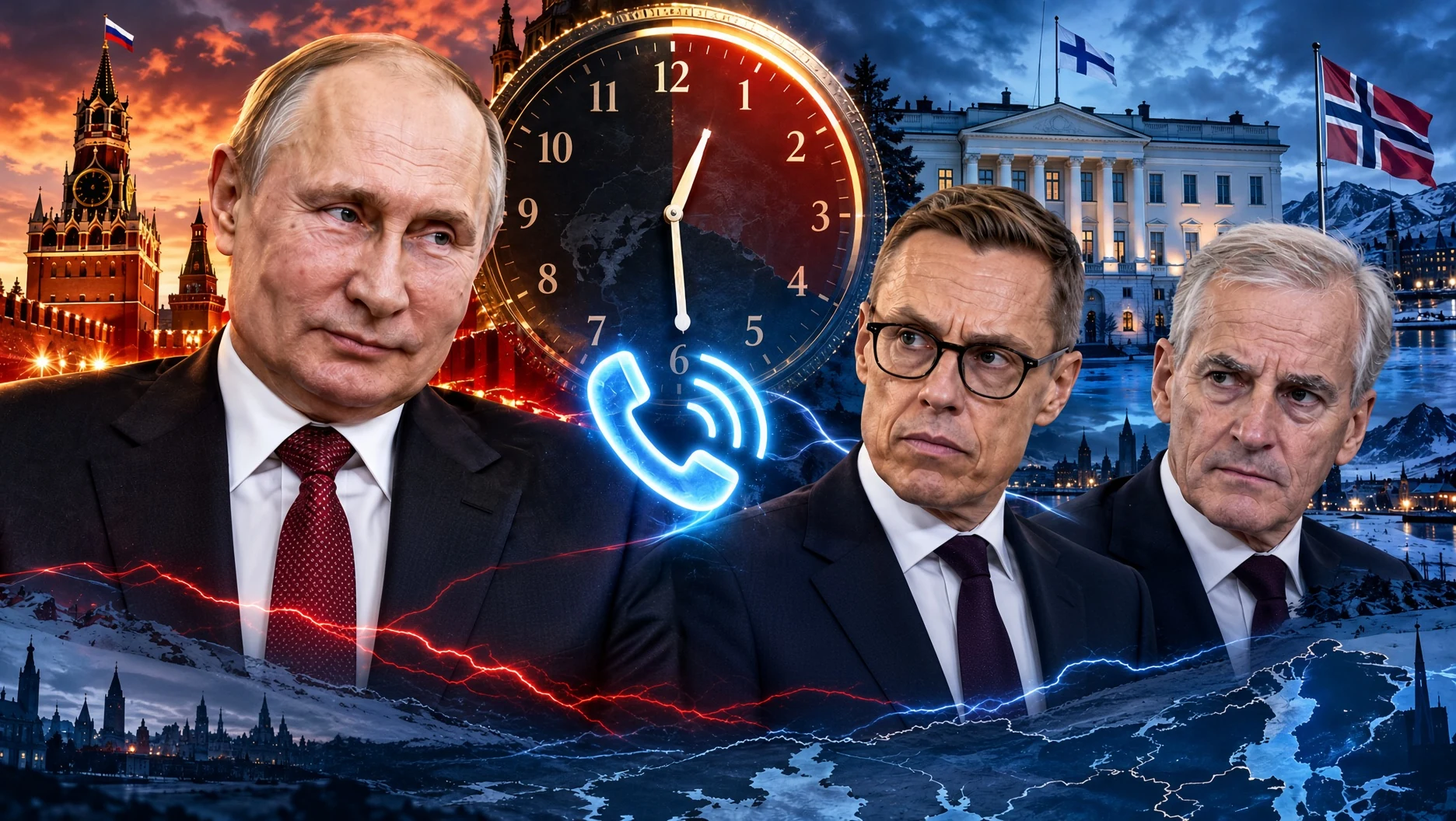 International diplomacy occasionally produces stories that sound as if they were written for a political comedy. On October 27, 2026, Finnish President Alexander Stubb and Norwegian Prime Minister Jonas Gahr Støre called Russian President Vladimir Putin.
The conversation lasted approximately 90 minutes, considerably longer than originally expected.
Within another day, however, the telephone call had produced a second international dispute.
This time, the argument was not directly between governments. It was between a British newspaper and one of the politicians who had participated in the conversation.
The Financial Times reported that Putin had spent much of the meeting discussing medieval Slavic history. Norway's prime minister publicly rejected that description.
Suddenly, a conversation intended to explore a path toward peace became a debate about what had actually been discussed.
According to official statements issued by the Finnish presidency and Norwegian government, Stubb and Støre initiated the conversation from Helsinki.
The call followed a meeting in Oslo on October 20 and was prepared in consultation with Ukraine.
Both Nordic leaders wanted to communicate directly with Putin ahead of expected negotiations involving Russian, Ukrainian and American representatives in Abu Dhabi.
Finland and Norway share land borders with Russia. Both are NATO members and strong supporters of Ukraine.
The call had reportedly been expected to last less than half an hour.
Instead, it continued for about 90 minutes.
The Financial Times offered a striking interpretation.
Citing sources familiar with the conversation, the newspaper reported that Putin devoted substantial attention to medieval Slavic history and the historical origins of the conflict as understood by the Kremlin.
Putin has frequently used historical arguments to explain his government's policies toward Ukraine.
Jonas Gahr Støre said the Financial Times portrayal was inaccurate.
According to his explanation, Putin discussed developments from 2014 onward rather than giving a prolonged lecture on medieval Slavic history.
Støre also disputed the suggestion that the Russian president had dominated the entire conversation.
He explained that translation consumed some of the available time and that the participants had broadly comparable opportunities to present their positions.
Finland and Norway requested a correction. Støre publicly said the newspaper’s account of the conversation was wrong.
Financial Times declined to amend its reporting and maintained its confidence in the original article.
What is clear is that the historical lecture claim remains disputed.
Historical explanations have been a recurring feature of Putin's public communication.
A particularly prominent example occurred in February 2024, when American journalist Tucker Carlson interviewed the Russian president in Moscow.
Instead of immediately answering questions about the contemporary war, Putin began with an extended account of Russian and Ukrainian history.
He discussed the development of early Russian statehood, historical territories, political divisions and the evolution of relations between Russia and Ukraine.
Such arguments are central to the Kremlin's explanation of the current conflict.
Russian officials frequently say that a lasting settlement must address what they describe as the conflict's underlying causes, including regional security arrangements.
Ukraine and its European partners reject aspects of Russia's historical and political justification for the invasion.
They emphasize Ukraine's sovereignty, internationally recognized borders and the need to end the fighting.
The disagreement is therefore more profound than a dispute over the wording of a potential ceasefire.
The parties have fundamentally different interpretations of the conflict's origins and the conditions required for peace.
The call also prompted disagreement among European leaders.
Danish Prime Minister Mette Frederiksen expressed skepticism about the Finnish-Norwegian initiative and questioned whether it served the interests of European coordination.
Støre defended the decision, arguing that allies had been informed and that maintaining direct contacts did not weaken Norway's commitment to Ukraine.
Stubb likewise stressed that the initiative had been coordinated with Kyiv.
Should European governments avoid direct communication with Moscow until conditions change?
Or should they maintain channels that allow messages to be delivered, even without immediate prospects for an agreement?
The conversation was not limited to Ukraine.
The leaders also discussed stability in the Baltic Sea region and Northern Europe.
The Baltic Sea has become an especially sensitive region as tensions between Russia and NATO have increased.
The Nordic initiative was linked to preparations for anticipated negotiations involving Russia, Ukraine and the United States.
However, no significant diplomatic breakthrough was announced after the October 27 call.
Moscow continued to insist that its security interests and demands must be taken into account.
Ukraine continued to prioritize sovereignty, security guarantees and an end to Russian military operations.
European countries remained divided over both negotiation strategy and the practical conditions for an acceptable settlement.
They require detailed negotiations, credible commitments and mechanisms capable of supporting any eventual agreement.
On October 29, Putin publicly welcomed the willingness of Stubb and Støre to engage in direct communication.
His remarks suggested that Moscow regarded the renewed contact as politically significant.
That does not establish that the two sides moved closer to a settlement.
In today's European security environment, a 90-minute call is enough to provoke political criticism, competing media reports and an international debate.
The October 27 phone call did not end the war in Ukraine or settle the disagreements between Moscow and European capitals.
It showed that direct communication remains possible even between governments with sharply opposing positions.
The Financial Times described a lengthy historical lecture. Norway's prime minister rejected that account. European leaders debated the wisdom of making the call in the first place.
The central challenge now is not whether another phone conversation will take place.
It is whether future discussions can move beyond public disagreements toward practical measures that reduce violence and establish conditions for a durable peace.
If political leaders and international media cannot agree on what happened during a single 90-minute conversation, how difficult will it be to agree on the security architecture of an entire continent?
Sources:
President of Finland: https://www.presidentti.fi/en/president-stubb-and-prime-minister-store-held-a-phone-call-with-president-putin/
Government of Norway: https://www.regjeringen.no/en/whats-new/president-stubb-and-prime-minster-store-held-a-call-with-president-putin/id3183597/
Financial Times: https://www.ft.com/content/a384acd1-c90c-4b71-bf7d-6c6e00bf9822
VG: https://www.vg.no/nyheter/i/Pgbv50/statsminister-jonas-gahr-stoere-snakket-med-putin
Reuters: https://www.reuters.com/world/europe/putin-says-moscow-seeks-better-european-ties-conflict-will-produce-no-winners-2026-10-29/