AN INDEPENDENT VIEW OF WORLD EVENTS EDITORIAL DESK | ENRU 
GEOPOLITICS · 31/10/2026
Slovakia Turns to Moscow as Europe’s Russian Gas Ban Approaches a Critical Test in 2027
Slovakia's Moscow talks, a gas contract running until 2034 and the EU's 2027 phase-out: what the dispute means for energy supplies, contracts and prices.
 A Diplomatic Visit With an Expensive Question
European energy policy has entered a particularly uncomfortable phase. Brussels has established a timetable for eliminating Russian natural gas imports, while some EU member states are still trying to calculate the financial consequences of implementing that decision. Slovakia has become one of the clearest examples of this tension. On October 26, 2026, Slovak Foreign Minister Juraj Blanár travelled to Moscow and met his Russian counterpart, Sergey Lavrov. The visit coincided with the resumption of the bilateral intergovernmental commission on economic, scientific and technical cooperation. Official discussions covered energy, nuclear power, agriculture, environmental protection, tourism, sports and culture. However, behind this extensive diplomatic agenda stood a much more immediate concern: Slovakia's long-term energy supply arrangements and the approaching European restrictions. The visit did not overturn EU policy, nor did it create a new gas agreement. Nevertheless, it demonstrated that the debate over Russian energy is far from settled within Europe. The Contract That Runs Beyond the Ban
One of the most important issues concerns Slovakia's existing natural gas contract with Russia. According to the Slovak Foreign Ministry, state-owned gas company SPP has a supply arrangement extending until 2034. The European Union, however, has adopted legislation requiring the phase-out of Russian gas imports considerably earlier. Under the regulation adopted on January 26, 2026, Russian liquefied natural gas supplied under long-term contracts will be prohibited from January 1, 2027. For long-term pipeline gas contracts, the relevant deadline is September 30, 2027, with a possible extension to November 1 under specified storage-related conditions. For Slovakia, this creates a potential legal and financial problem. Blanár has warned that the existing agreement contains take-or-pay provisions, under which the buyer may face contractual obligations even when it does not receive the agreed quantities. The minister estimated that possible financial claims could exceed €10 billion and potentially rise to €16 billion. Those figures are the Slovak government's assessment of potential exposure, not an established liability confirmed by a court. Still, the concern is substantial. A European regulation may end permission to import gas, but it does not automatically resolve every contractual disagreement between commercial parties. That distinction could become increasingly significant as the deadline approaches. Why Slovakia Still Wants Russian Energy
Slovakia's interest in continuing energy cooperation with Russia is rooted in infrastructure, commercial arrangements and the practical requirements of its economy. Russian gas supplies to Central Europe have historically depended on long-established pipeline networks. After the termination of the Ukrainian transit route at the beginning of 2025, the southern route through TurkStream became particularly important for continuing deliveries to the region. Oil represents a separate issue. During the October 26 meetings, Slovak and Russian representatives discussed the importance of maintaining stable Russian oil supplies through the Druzhba pipeline. The distinction matters: Druzhba is an oil pipeline, not a natural gas transmission system. Nuclear energy adds another layer of complexity. Slovakia operates nuclear power facilities at Bohunice and Mochovce, which were originally developed using Soviet-era reactor technology. On October 27, Slovak State Secretary for the Economy Vladimír Šimoňák reaffirmed the country's intention to continue purchasing Russian natural gas where legally permitted and to maintain cooperation on nuclear fuel. He emphasised that Slovakia would respect restrictions arising from EU law while defending its national economic interests. This is not simply a dispute over diplomatic preferences. It involves industrial infrastructure that cannot always be replaced quickly or cheaply. Europe's Gas Storage Challenge
The timing of the renewed negotiations is particularly important because Europe is preparing for another winter. According to Gas Infrastructure Europe, EU underground gas storage facilities were approximately 74.9% full on October 29, 2026. Germany's storage level stood at around 61.6%, while Austria recorded approximately 67.5%. These figures do not establish that Europe will suffer widespread heating shortages. Gas storage is only one component of supply security. Pipeline imports, LNG deliveries, electricity generation, weather conditions, consumption and international market developments also influence the outlook. Nevertheless, lower storage levels reduce the cushion available against unexpected disruptions. A prolonged cold spell, strong international LNG demand or logistical difficulties could place additional pressure on prices. The European Union Agency for the Cooperation of Energy Regulators also reported in October that storage refilling had become more expensive during 2026. This makes energy affordability an increasingly important political issue, particularly for industrial businesses and lower-income households. Why Brussels Wants to End Russian Gas Imports
The European Union's position is based on energy security and geopolitical considerations following Russia's full-scale invasion of Ukraine in 2022. European institutions argue that excessive reliance on Russian gas exposed member states to dangerous supply risks. The REPowerEU programme was developed to diversify energy sources, improve infrastructure, reduce dependence on imported fossil fuels and strengthen European energy resilience. Significant changes have already taken place. According to European Commission data, Russia supplied approximately 45% of EU gas imports in 2021. By 2025, that share had declined to around 12%. Alternative sources, including Norway and the United States, have taken on a larger role. LNG terminals and cross-border infrastructure have also expanded. These developments have reduced Europe's dependence on a single supplier and increased flexibility in some parts of the market. Yet diversification creates its own challenges. LNG prices are affected by worldwide demand, shipping costs, terminal capacity and geopolitical disruptions. Europe is now more directly exposed to competition with Asian buyers for globally traded gas. In other words, moving away from Russian pipelines can reduce one category of risk without eliminating energy-market volatility. That is the economic dilemma behind the political argument. Robert Fico and the Debate Inside Slovakia
Prime Minister Robert Fico's government presents its energy strategy as a defence of Slovakia's national interests. Its representatives argue that economic realities must remain central to European decision-making. Maintaining communication with Moscow, according to this position, is necessary to manage contracts, energy supplies and other areas not directly restricted by sanctions. Slovak opposition parties have strongly challenged this approach. Critics argue that high-level engagement with Russian officials risks weakening European unity and sending the wrong diplomatic message while the war in Ukraine continues. These competing views reflect a broader European disagreement between immediate economic interests and longer-term strategic security goals. The central question is not whether energy security matters. Both sides say that it does. The disagreement concerns which risks deserve priority and which costs are acceptable. For voters, the political debate becomes tangible when it affects household bills, employment, industrial competitiveness and public finances. Germany and Austria Face Similar Political Arguments
The Slovak debate is not entirely isolated. In Germany, Alternative for Germany politicians have called for renewed energy cooperation with Russia, arguing that affordable fuel is necessary for consumers and industrial competitiveness. In Austria, the Freedom Party has also raised objections to restrictions on Russian energy imports. These statements do not mean that national governments are preparing to abandon EU law. Nor do opinion polls or opposition-party demands automatically translate into new European legislation. However, they demonstrate that energy policy continues to divide political movements across the continent. When economic conditions become difficult, the cost of energy can quickly move from a technical regulatory issue into the centre of election campaigns. Can the EU Change Its Gas Ban?
The regulation contains narrowly defined emergency provisions allowing temporary suspension under serious supply-security circumstances. However, such provisions should not be confused with the general cancellation of the phase-out policy. The most likely pathways involve continued diversification, negotiations over contractual consequences, legal disputes and possible emergency arrangements if supply security deteriorates. Slovakia may continue challenging aspects of the policy, but there is no guarantee that its objections will lead to an exemption. The commercial implications of existing contracts also remain uncertain. Much will depend on the precise contractual terms, applicable law and any future legal proceedings. For businesses, those uncertainties complicate long-term planning. For governments, they create additional pressure to maintain affordable energy while preserving their strategic objectives. What Happens Next?
The year 2027 is becoming a critical milestone for European energy policy. For Brussels, success would mean completing the phase-out of Russian gas without major supply disruption and with manageable economic costs. For Slovakia, success would mean protecting supply security while limiting financial exposure from existing contracts. For Russia, the issue concerns maintaining commercial relationships and managing the loss of European export markets. Each side approaches the situation with different priorities. The October meeting between Blanár and Lavrov illustrates how difficult it can be to reconcile those priorities, particularly when political decisions and long-term commercial obligations operate on different timelines. The Bigger Picture
Slovakia's Moscow visit is neither proof that the European Union's energy strategy has failed nor evidence that Russian gas will inevitably return to all European markets. It is, however, an important reminder that energy transitions have financial, industrial and legal consequences. The EU has successfully reduced its dependence on Russian gas, but the next stage will test the affordability and resilience of its replacement arrangements. Slovakia is seeking to defend its economic interests while remaining bound by European legislation. As the 2027 deadline approaches, the most meaningful measure of success will not be the number of political declarations issued in Brussels, Bratislava or Moscow. It will be whether European households and businesses can obtain reliable energy at sustainable prices. That is where diplomatic ambitions ultimately meet economic reality.
Sources: Slovakia's Ministry of Foreign Affairs — https://www.mzv.sk/sk/web/en/pressreleasedetail?articleId=60677847&groupId=10182&p_p_id=sk_mzv_portal_pressrelease_detail_portlet_PressReleaseDetailPortlet&p_p_lifecycle=0; Council of the European Union — https://www.consilium.europa.eu/en/policies/ending-russian-energy-imports/.
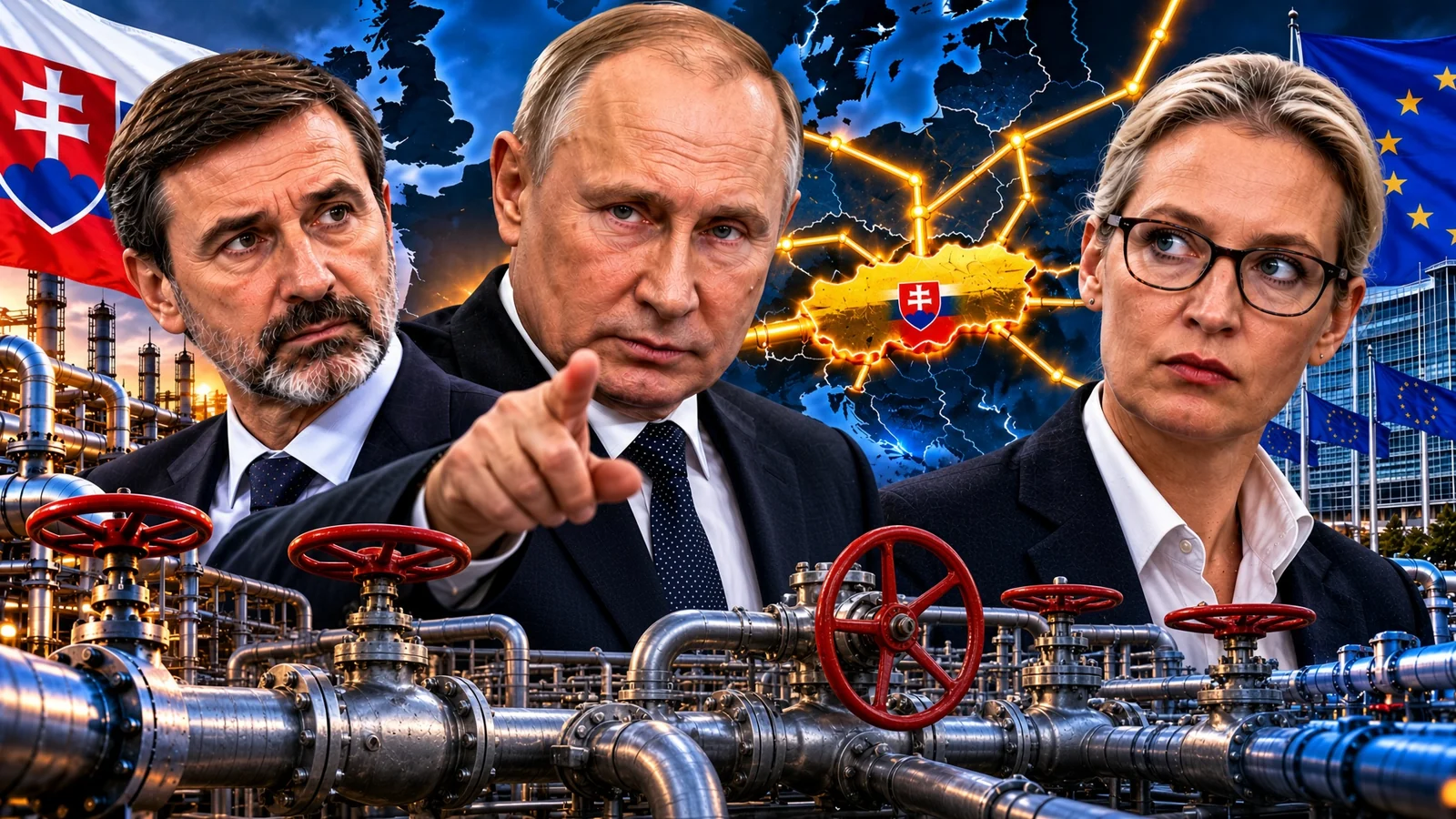
Illustration: editorial composite. Not a documentary photograph of the negotiations.